 Game Night & Party
A Quizduell Alternative for Real Game Nights: Opponents in the Room
Quizduell taught millions of people that a quiz belongs on a phone. Two minutes on the train, three questions, hand the turn to your opponent, carry on when they play back. For that purpose the app is still hard to beat.
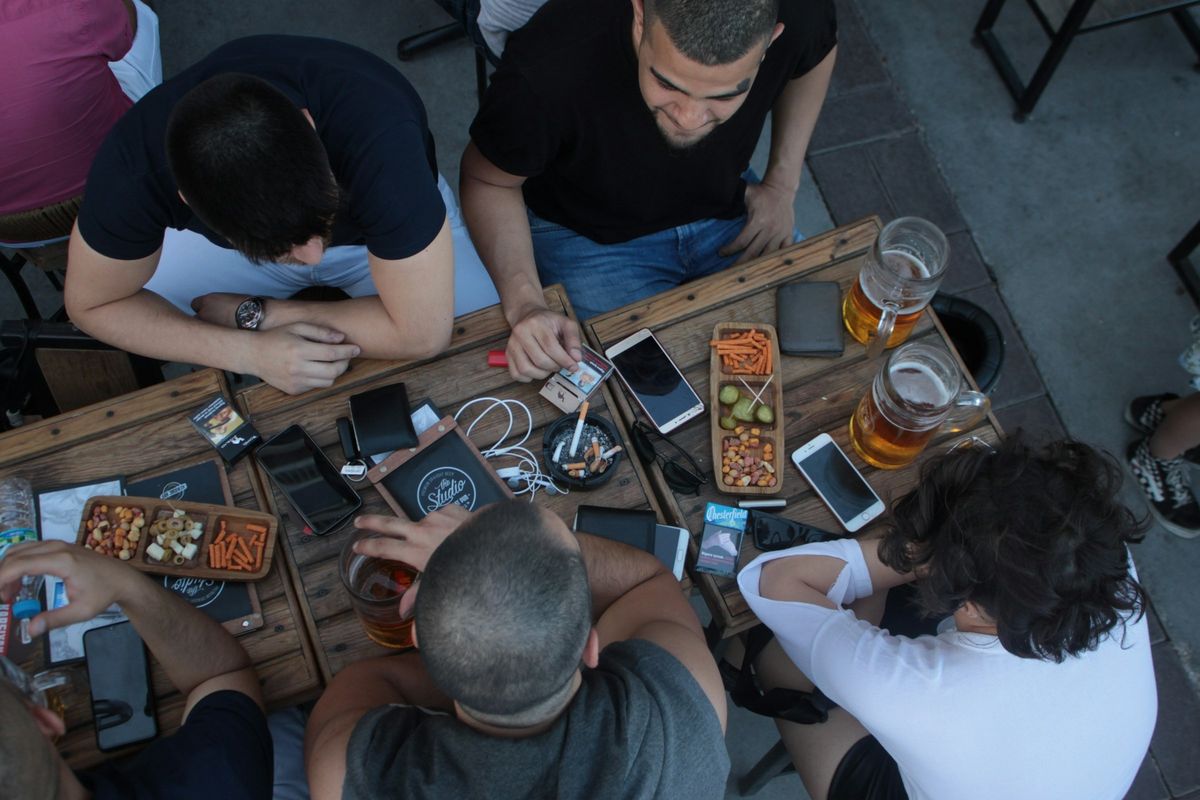
At a game night, though, this regularly happens: six people sit around a table, everyone opens the app, and twenty minutes later everyone is staring at their own screen. The evening isn't bad – it just isn't happening together.
That is not an accident, it's construction. Quizduell is built for one person with time to kill, not for a group at a table. This piece looks at the mechanics behind that – and at a variant that uses the same technology but is built for the room.
What Quizduell got right
- A round is short enough for any gap in the day. Three questions take less time than two stops on a train.
- Asynchronous was the right call. Nobody has to agree when to play. Your opponent answers when they have a moment.
- Multiple choice is unbeatably fast. Four answers, one tap, next. No keyboard, no worrying about spelling.
- Categories make progress visible. Realising you reliably win at geography keeps you playing.
None of those four are mistakes. They are exactly right for the purpose. Each of them simply flips the moment more than two people are in the same room.
Why it doesn't carry a game night
Multiple choice rewards guessing, not judgement
With four options, the guess rate is 25 percent. Someone with no idea taps and is right one time in four. At a table that produces the dullest round there is: half the group guesses, the other half knows, and nobody talks, because there is nothing to talk about.
Asynchronous means no shared moment
The best moment of a quiz evening is the second between question and answer when everyone is thinking at once. That moment does not exist when everyone plays at their own pace. Six people play six different questions – there is nothing everyone shares.
A duel is a game for two
The name is honest. Six people produce three pairings or fifteen individual duels, but not one round. Anyone who can't find an opponent at the table sits out.
The outcome is settled early
Whoever owns the categories wins. There is no move that lets somebody without knowledge take anything – and therefore no reason for the others to stay involved to the end.
What a game night mechanically needs
Three conditions any group game can be measured against:
- Everyone is occupied at the same time. No turns, no waiting, no running order.
- There is a shared moment. Everyone sees the same question and the same reveal at the same time.
- The outcome stays open. Even people who know little have a route to winning until the end.
Quizduell meets point 1 inside a duel and misses points 2 and 3. That is exactly where the alternative starts.
Quizduell for a real game night
QuizPoker keeps the technology that made Quizduell big: everyone plays on their own phone, no equipment, no installation. Two components are swapped out.
First: one shared round instead of pairwise duels. One person creates a lobby and shares the six-character code, everyone else joins – 2 to 8 players in the same game. Everyone gets the same question at the same time.
Second: estimation questions instead of multiple choice. Not "in which year did the Berlin Wall come down?" with four options, but "how many kilometres long was the Berlin Wall?" There is nothing to tap. Everyone enters a number.
The effect on the group is bigger than it sounds: nobody knows the exact answer to an estimation question. So there is no person who "has" the category and no person without a chance. There are only people who land closer – and people who judge their own certainty better.
The part Quizduell doesn't have: stakes
Between the question and the reveal, you bet, as in poker. That is the move that turns a knowledge test into a game for mixed groups.
Every question runs over four betting rounds and takes about five minutes:
- The question appears. Everyone enters an estimate, unseen and simultaneously. First betting round: call, raise or fold.
- The first hint appears. Every question has two. Second betting round: check, bet, raise or fold.
- The second hint appears. Third betting round, same options.
- The reveal. One final betting round follows, then everyone still in shows their number. Closest to the answer takes the pot – only the distance counts, not the direction.
So even the person at the table who can't keep up in any category has a route to winning every round: raise convincingly until everyone else folds. If you want to know how that works, the poker bluffing tips cover the basics.

Why estimation questions work better in mixed groups
An example from a real round. The question: "What is the population of Iceland?"
As multiple choice with the options 190,000, 390,000, 790,000 and 1.4 million, it's over in four seconds. You know it or you tap wrong.
As an estimation question, something else happens. Someone thinks out loud: "Reykjavík is about the size of a mid-sized European city, and the rest of the island is nearly empty." Someone else: "They qualified for a European Championship – you can do that with under a million." Both are wrong, and both have reasoning. The conversation is the yield of the evening, and multiple choice doesn't produce it.
The answer: around 390,000. For comparison, that's roughly the population of Bochum.
Side by side
Situation Quizduell: alone, on the move, against one opponent. QuizPoker: 2 to 8 people, one round, same room or spread out.
Question type Quizduell: multiple choice, four options. QuizPoker: estimation questions with two hints, free number entry.
Flow Quizduell: asynchronous, turn by turn. QuizPoker: everyone at once, every round.
When you don't know Quizduell: a 25 percent guess rate. QuizPoker: fold and lose little – or raise and take the pot without knowing.
Amount of conversation Quizduell: low, because everyone plays alone. QuizPoker: high, because people calculate, bluff and comment between betting rounds.
Effort Both: no equipment. QuizPoker runs in the browser, with no installation and no account.
When Quizduell is still the better choice
Being honest here matters, because these are two different occasions.
Quizduell is better when you are alone, when you have two minutes, when you want to play one particular person over several weeks, or when you simply enjoy pure factual knowledge. A game against a friend in another city, three questions a day – nothing beats it.
QuizPoker is better when people are in the same room, when the group is mixed – one person reads a lot, another doesn't – when you want to fill an evening rather than a bus ride, and when somebody should win at the end without everyone having known it in advance.
What you need
One smartphone per person. Create a lobby, share the code, join – no download, no registration, no equipment. Over 400 estimation questions across 18 categories, played by 2 to 8 people.
If you would rather play at the table with real chips, you can: the app supplies the questions and hints and you handle the rest. The full rules are in the game instructions.
On cost, without the runaround: three questions free, then unlimited. A pass from 4.99 € unlocks 24 hours of unlimited play. No subscription — nothing renews automatically.
Conclusion
Quizduell is built for the train and excellent there. A game night needs something else: a shared question, a shared moment and an outcome that stays open until the final bet.
If six people regularly sit next to each other at your place and all look into their own screens, one round of QuizPoker is the obvious test. Same devices, same effort, different evening.
Read on: planning a game night for the running order, Stadt Land Fluss: categories and variants for the game before it, and the quiz board games comparison if it should come off the shelf after all.
Tags
quizduell quizduell alternative quiz app quizspiele spieleabend schätzfragen quizpoker