 Activities & Leisure
Freshers' Week 2026: 12 Icebreaker Games for the Semester Start
The 2026/27 winter semester begins on 1 October, lectures start at most German universities around 12 October, and in between sits the week that shapes the entire first year for many students: freshers' week. Anyone who meets nobody during those seven days is sitting alone in the library by November. Anyone who manages it has a study group, a room in a flatshare, and three people to spend New Year's Eve with.
The problem: you can't order people to get to know each other. What works are situations where talking happens as a side effect – and that is what games are for. Here are twelve that work with thirty strangers in a seminar room or eight people in a flatshare kitchen.
Key Dates for the 2026/27 Semester Start
- Semester begins: 1 October 2026
- Lecture period: usually from 12 October 2026 to early February 2027
- Orientation weeks: at most universities in the first half of October, some starting 1 October
- Christmas break: roughly 19 December 2026 to 2 January 2027
Every university sets its own exact dates – it's worth checking your own academic calendar, especially if the student council is planning its own freshers' trips or social evenings.
Why the First Two Weeks Matter So Much
There is a simple reason freshers' weeks are so intense: on day one, everyone is in the same state. Nobody knows anybody, nobody has a group, everyone is equally unsure. It is the only moment in the whole degree when you can talk to complete strangers without it seeming odd.
After two or three weeks that window closes. Groups have formed, lecture-hall seats are claimed, group chats are set up. Joining later is possible, but noticeably harder.
This isn't only true for first-year students. Anyone moving into a new flatshare, starting a semester abroad or joining a new course has the same window.
What Makes a Good Icebreaker
Most icebreakers fail on the same three points. What a game for freshers' week has to deliver:
- Nobody has to expose themselves. A game where someone has to stand alone in front of the group and perform isn't an icebreaker, it's an exam. Anyone shy checks out immediately.
- No obligation to drink. Alcohol as an entry ticket excludes a substantial part of any group – for religious, health or simply personal reasons. Every game here works without it.
- A conversation starter, not an end in itself. The goal isn't to win the game. The goal is that two people keep talking afterwards.
- Playable without equipment. Nobody brings a board game to freshers' week. What runs on a phone or on slips of paper gets played.
12 Icebreaker Games for Freshers' Week
For Large Groups (15+ people)
1. Two Truths, One Lie
The classic, and for good reason. Everyone gives three statements about themselves, one of them invented. The group guesses. Works in a seminar room, on the coach to the freshers' trip and in the canteen queue. The advantage: you learn three things about a person instead of just their name.
2. Human Bingo
A sheet with 16 squares: "has been to Japan", "plays an instrument", "has siblings", "hates coriander". Everyone walks around looking for people each statement applies to. First to fill a row calls bingo. Creates more first contacts in ten minutes than an entire lecture.
3. The Name Chain
Going round, each person says their name plus the names of everyone before them. Sounds like a children's party, but it's the only game after which people actually remember names. Workable up to 20 people.
4. Line Up Without Talking
The group silently sorts itself by birthday, distance from home town or shoe size. Everyone has to communicate without speaking. Takes five minutes and breaks any ice.
For Medium Groups (6 to 12 people)
5. QuizPoker
The game for the first flatshare evening. QuizPoker gives you estimation questions nobody knows the exact answer to – how many students are enrolled at German universities, how deep Europe's deepest lake is, how many cups of coffee are drunk per person per year. Everyone enters a number, then you bet.
Each question has four betting rounds – after the question, after the first hint, after the second hint and in the final round once the answer is revealed. In each round you can check, bet, raise or fold. Whoever lands closest to the number, or pushes everyone else out, takes the pot.
Why it works as an icebreaker: there is no knowledge barrier. Nobody embarrasses themselves, because everybody is wrong. And in twenty minutes you learn very precisely who in the group plays it safe, who gambles, and who talks nonsense with a straight face. That is more information about a person than any round of introductions.
It plays with 2 to 10 people, everyone on their own smartphone – so it needs nothing that isn't already there. Over 400 estimation questions across 18 categories. Three questions free. Unlimited after that.
6. Never Have I Ever
Going round, someone says a sentence starting with "Never have I ever." Anyone who has done it raises a hand – or takes a sip, if that's how the group plays it. Important: water counts too. The game runs on the reactions, not the alcohol.
7. The Question Pile
A stack of slips with questions: "What was your worst side job?", "Which subject did you nearly study?", "What's the strangest thing in your fridge?" Everyone draws and answers. Lasts as long as you want and is the lowest-barrier entry there is.
8. Taboo Without Cards
Someone thinks of a term and whispers it to their neighbour, who explains it without using the word itself. No materials, no preparation, works across any language mix – an advantage in international degree programmes.
9. Werewolf
From eight people up, the best game for a long evening. Writing roles on slips of paper is enough; you don't need a card set. The drawback remains: eliminated players watch. So save it for later in the evening, when people are already talking.
For Small Groups (2 to 5 people)
10. The Kitchen Tour
Not a game in the strict sense, but the most effective flatshare icebreaker there is: everyone shows one object from their room and explains in two sentences why it made the move. Works better on the first night in a new flat than any board game.
11. Categories with Your Own Headings
Swapping the categories makes the difference: "excuse for missing a lecture", "canteen dish", "series you should admit to watching". Needs nothing but paper and pens.
12. Cooking as a Contest
Two teams, same budget, same time, one dish. The flatshare kitchen is where most first-semester friendships start anyway. Turning it into a competition only speeds it up.
A Plan for the First Flatshare Evening
The classic mistake on a first evening: too much programme. What works:
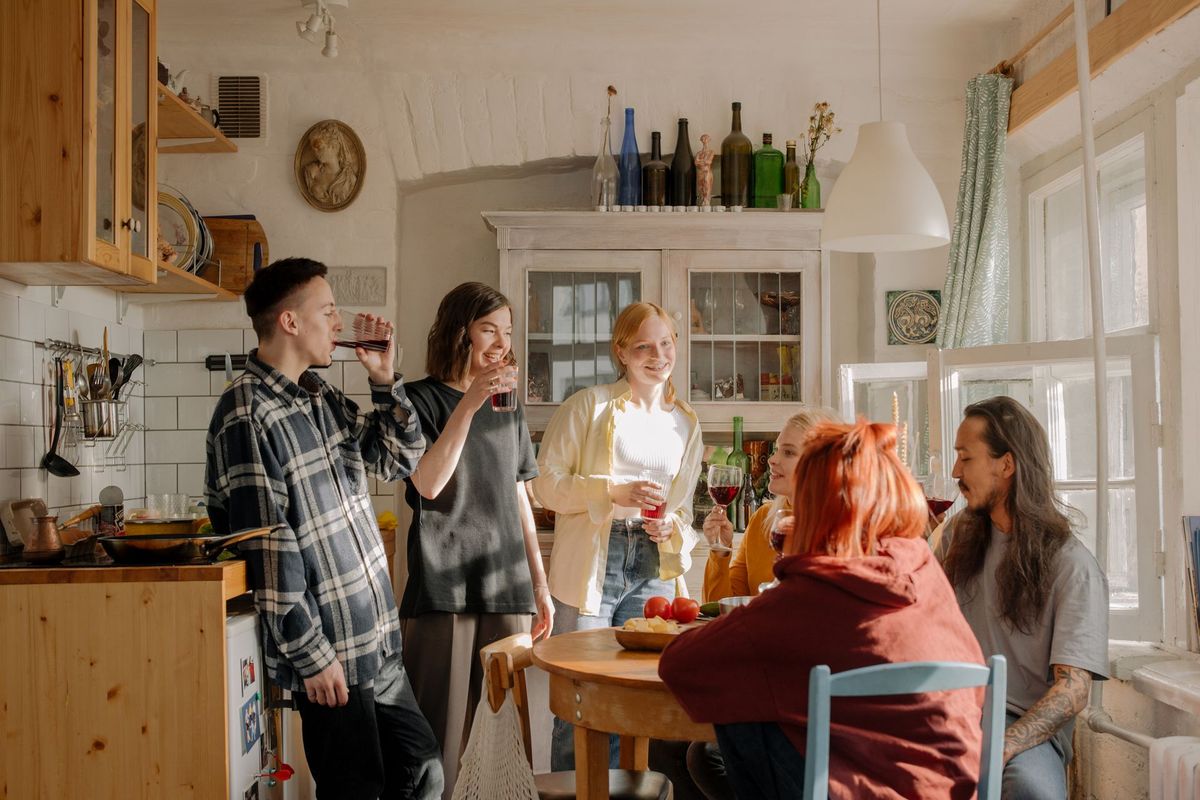
- 19:00 – Arriving, someone cooks, everyone stands in the kitchen
- 20:00 – Eating, question pile running in the background
- 21:00 – First proper game round: QuizPoker or taboo
- 22:30 – Werewolf, if enough people are there
- from 24:00 – Small group, music, talking
The most important moment is 21:00. After eating, a gap opens where the group either tips into conversation or into phone screens. A game that keeps everyone at the table decides which way it goes.
What to Avoid
- Don't force anyone to play. Whoever wants to watch, watches. Most join in on their own after twenty minutes.
- No games built on embarrassment. In week one nobody knows each other well enough to laugh at themselves. That comes later.
- Don't make drinking games the only offer. An evening built purely on drinking filters the group – by the wrong criterion.
- Nothing over 45 minutes at a first meeting. Anyone still learning rules after an hour leaves.
For Flatshares: One Fixed Evening Beats Ten Spontaneous Ones
The most effective trick for a flatshare that actually gets along: a fixed date. The first Thursday of the month, always, regardless of who can make it. Whoever's there is there. After three months it's routine; after a year it's the thing holding the flat together.
We collected more on that in our post Flatmate Night Ideas.
Conclusion
Freshers' week doesn't decide your grades, but it decides almost everything else. You don't need twelve games – two are enough. One for large groups, one for the smaller evening afterwards.
If you take one thing away: pick a game where not knowing isn't a disadvantage. That's the whole point of QuizPoker – nobody knows the answer, everybody guesses, and the person who simply bets bravely can win. For a group where nobody knows anybody yet, that's the best starting position there is.
More ideas for the first few weeks are on our game night page.
Tags
ersti woche kennenlernspiele semesterstart wintersemester 2026/27 studenten wg spieleabend quizpoker